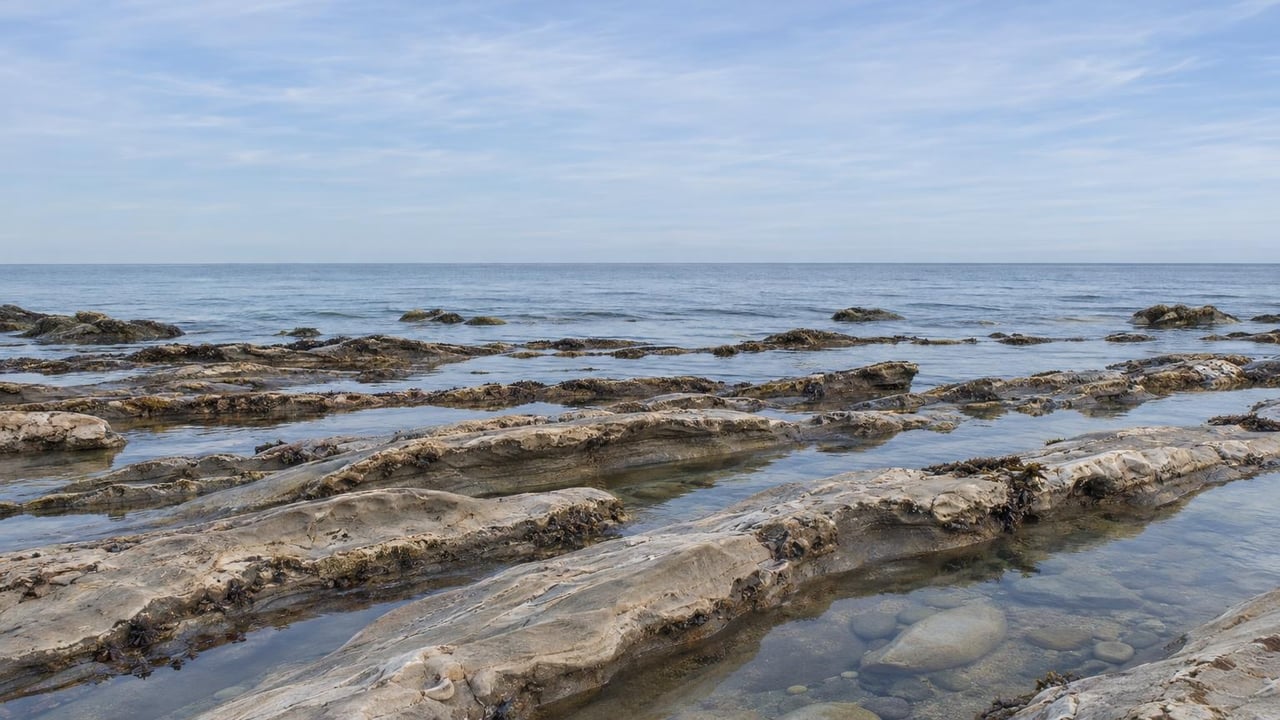
On Christmas Eve, Santa Barbara gets the lowest daylight tide of December. NOAA's tide station at Santa Barbara predicts the water will bottom out at 1.91 feet below the usual low-water mark at 4:17 p.m. on December 24, 2026. The sun sets at 4:54 p.m. that day, so you have 37 minutes on the rocks at the bottom of the tide before it gets dark.
On January 21, 2027, four weeks later, the tide drops a little further, to minus 1.95 feet, at 3:15 p.m. Sunset that evening is at 5:17 p.m., which leaves two full hours of light. The reef is just as exposed, and you get more than three times as long to see it. For anyone who has been meaning to explore the pools below the Mesa this winter, January 19 through 22 is the window to plan around.
Why the best tides keep landing at dusk
As the Santa Barbara Independent put it in its tide-pooling guide, about every two weeks the lunar cycle produces "higher high tides and lower lows," and those extreme lows expose habitat that normally stays underwater. The predictions for this winter follow that rhythm closely. Each two-week set has about a week of negative tides, and the low comes 35 to 45 minutes later each day.
That daily drift explains the timing problem. Every negative low NOAA predicts for Santa Barbara in December 2026 and January 2027 comes in the afternoon or evening, from about 1 p.m. to 7:18 p.m. on December 28. Each set starts early in the afternoon, gets deeper as the lows move later, and peaks right as the tide is running into sunset. In the Christmas set, the last few lows come after dark. In January, the final low of the deep set still comes eight minutes before sunset.
Over the Christmas set, sunsets get later by only about a minute a day. In January they get later by about a minute a day too, but they start 20 minutes later than in December, and the January lows run earlier in the afternoon. Together those two shifts give January its advantage.
The two deep sets, day by day
The table covers both deep sets of the season. Low tide times and heights come from NOAA's predictions for station 9411340, in feet relative to mean lower low water. Sunset times are from timeanddate.com's Santa Barbara tables for December 2026 and January 2027.
| Date | Low tide | Height | Sunset | Light after the low |
|---|---|---|---|---|
| Mon, Dec 21, 2026 | 2:01 p.m. | -1.01 ft | 4:52 p.m. | 2 hr 51 min |
| Tue, Dec 22 | 2:45 p.m. | -1.53 ft | 4:53 p.m. | 2 hr 8 min |
| Wed, Dec 23 | 3:31 p.m. | -1.84 ft | 4:53 p.m. | 1 hr 22 min |
| Thu, Dec 24 | 4:17 p.m. | -1.91 ft | 4:54 p.m. | 37 min |
| Fri, Dec 25 | 5:03 p.m. | -1.77 ft | 4:54 p.m. | Low falls after sunset |
| Sat, Dec 26 | 5:49 p.m. | -1.42 ft | 4:55 p.m. | Low falls after sunset |
| Mon, Jan 18, 2027 | 1:06 p.m. | -0.70 ft | 5:14 p.m. | 4 hr 8 min |
| Tue, Jan 19 | 1:52 p.m. | -1.32 ft | 5:15 p.m. | 3 hr 23 min |
| Wed, Jan 20 | 2:34 p.m. | -1.74 ft | 5:16 p.m. | 2 hr 42 min |
| Thu, Jan 21 | 3:15 p.m. | -1.95 ft | 5:17 p.m. | 2 hr 2 min |
| Fri, Jan 22 | 3:55 p.m. | -1.91 ft | 5:18 p.m. | 1 hr 23 min |
| Sat, Jan 23 | 4:34 p.m. | -1.63 ft | 5:19 p.m. | 45 min |
| Sun, Jan 24 | 5:12 p.m. | -1.15 ft | 5:20 p.m. | 8 min |
In December, the best mix of depth and daylight comes on December 22 and 23, before the holiday itself. A tide of minus 1.84 feet at 3:31 p.m. on the 23rd leaves well over an hour of light after the low. Christmas Eve gives you the lowest number of the month, but the 37 minutes of light after it go quickly once you've walked down from the bluff. On Christmas Day and the day after, the lowest water comes after sunset.
January's set runs deeper on more days that still have plenty of light. From January 20 through 22, every low is below minus 1.7 feet with at least 80 minutes of daylight after it, and two of those three days have two hours or more. January 21 has the lowest predicted tide of the two months and comes on a Thursday afternoon. If you work weekdays, Saturday, January 23 has a minus 1.63 foot tide at 4:34 p.m., with sunset 45 minutes later.
Two shallower sets to warm up on
Each deep set has a milder set about two weeks before it. Those milder tides are a good way to learn the access points before the big days. From December 5 through 12, NOAA predicts negative lows every afternoon, bottoming out at minus 0.68 feet at 3:44 p.m. on Tuesday, December 8. From January 3 through 10, the lows range from minus 0.39 to minus 0.80 feet. The lowest is minus 0.80 feet at 3:31 p.m. on Wednesday, January 6, and Saturday, January 9 has minus 0.60 feet at 4:58 p.m.
These tides are less than half as deep as the minus 1.9 foot tides later in each month, but they still uncover the upper pools. They also give you a chance to see where the stairs come out, which rocks are slick and how long the walk back takes.
Where to go down to the rocks
The City's own environmental review gives you the stretch of coast to focus on. In the biological resources chapter of its Housing Element EIR, the City describes the tidepool habitat between Leadbetter Point and Arroyo Burro Beach as supporting anemones, mollusks and crustaceans. The same chapter describes the nearshore reef from Hope Ranch to Leadbetter as mostly rocky reef with smaller fish and invertebrates, including spiny lobster. The City's access points down to that stretch are listed below from east to west.
Shoreline Park and Leadbetter. Shoreline Park sits at Shoreline Drive and Santa Rosa Place, and a stairway runs from the park down to the beach. The City lists that stairway as Shoreline Steps. If you want to start at sand level, Leadbetter Beach Park next to the harbor has a paid lot on site. The Independent's guide names Leadbetter among the headlands with the best rocky-shore access in the region. On a short-daylight day like Christmas Eve, this is the easiest end of the coast to reach.
Thousand Steps. The City describes Thousand Steps, originally called Camino al Mar, as a 157-step, multi-tier stairway from the cliffs at the end of Santa Cruz Boulevard to the beach. It was built in 1925. The City's repair project page lists that project as on hold until more sand builds up naturally at the base, so look at the page before you plan around these stairs.
Mesa Lane Steps. The City notes that Mesa Lane Steps is the only cliff-to-beach access for a mile in either direction. An Independent beach-walk guide counts 241 steps from top to bottom, so plan for the climb on the way back. On the deep January days, allow time for it when you decide how long to stay out.
Arroyo Burro. The entrance to Arroyo Burro Beach is off Cliff Drive. The Santa Barbara Museum of Natural History includes Arroyo Burro on its list of regional tide-pool sites. The Independent's guide says heading west from the beach brings "plenty of tidepooling at lower tides." Heading east on medium or lower tides, you can walk all the way to Shoreline Park. The same guide describes a loop that goes east along the sand, climbs the Mesa Lane steps and returns along the bluff through the Douglas Family Preserve. The City lists the Douglas Family Preserve at 2551 Medcliff Road, above Arroyo Burro Beach. The loop fits the January tide schedule well. On January 20 or 21, you can walk the beach at the bottom of the tide and be back up on the bluff trail as the sun goes down.
What turns up when the water drops
The Independent's guide lists the regular finds on South Coast rocky shores as anemones, mussels, keyhole limpets and turban snails. It says patience can turn up sea hares, small bat stars, purple urchins, kelp crabs, tiny fish, "and maybe even an octopus guarding her eggs." That list covers the region, so no single reef is guaranteed to have all of it. The Museum of Natural History says what you see depends on the tide and the location: barnacles and anemones almost anywhere, and sea stars and octopuses "if you're patient and lucky." The deeper tides give you a better shot at the less common animals because they uncover more of the lower reef.
Before you head down
The Museum's tide-pool advice is to check the low-tide time before you go, look at the animals without handling them, and wear clothes and shoes for wet, slippery rocks in wind and cold. The Independent's guide says the same about collecting: "look and to study, but not to take." In winter, the daylight in the table matters as much as the footwear. Plan to be back at the stairs by the sunset time on the date you pick, and check the City's page for your access point that morning.
If you're hosting family over the holidays or in January, a December 22 or January 21 afternoon at the reef is a good outing to plan for them, much like the new trails at Franceschi Park up the hill. If they'd rather have a place of their own near the coast, see where they can stay with Vacation Rentals of Santa Barbara.
At Samantha Ireland, we think low-tide afternoons are some of the best days on this coast. If you own a home near the Mesa and want your guests to know which afternoons to save for the reef, Let's Connect.